The Story of Warli Art
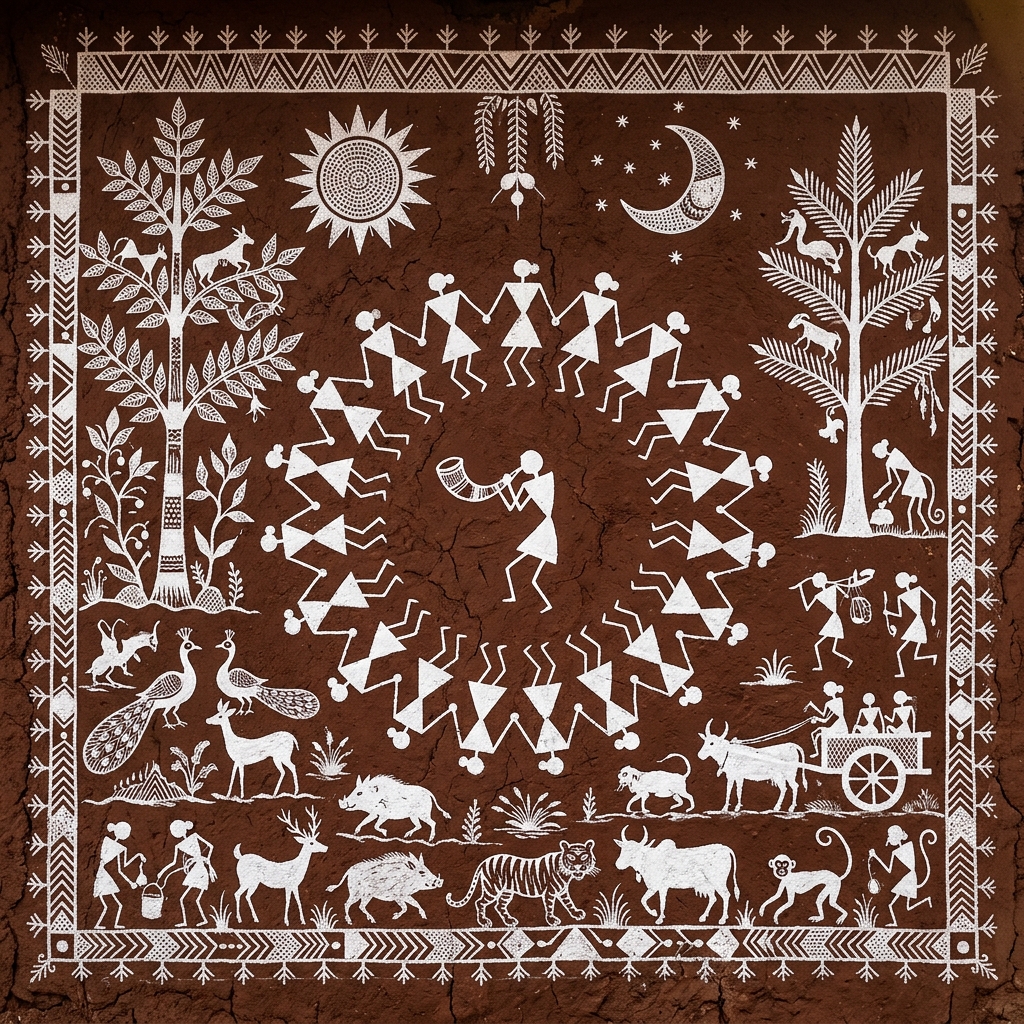
Nestled in the rugged Sahyadri ranges of Maharashtra, the Warli tribe has preserved a unique and ancient visual language for millennia. Unlike other traditional art forms that depict elaborate deities and courtly scenes, Warli painting is a humble, earthy celebration of daily life, community, and an unshakeable connection to Mother Nature.
Geometric Roots of the Cosmos
The visual vocabulary of Warli art is deceptively simple, consisting of only three basic geometric shapes: the circle, the triangle, and the square. These shapes are not abstract choices; they are direct observations of their natural environment. The circle represents the celestial bodies—the sun and the moon—which dictate the rhythms of tribal life. The triangle represents mountains and conical trees. The square, known as the 'Chauk' or 'Chaukat', represents the sacred enclosure, denoting fertility, the earth, and the mother goddess Palaghata.
The Ritual of Rice Paste
Traditionally, Warli paintings were not painted on canvases but directly on the walls of mud huts. The walls were prepared using a mixture of cow dung, earth, and red clay, which provided a warm, dark terracotta background. The white pigment was made from ground rice paste mixed with water and a tiny bit of acacia gum for binding. The painting tool was a simple bamboo stick with its tip chewed to form a soft brush. This organic process connects the painting directly to the materials of the land.
“In Warli art, there are no depictions of mythological characters or deities. Instead, the focus is entirely on the daily life of the community and their harmonious relationship with nature.”
The Tarpa Dance: A Celebration of Unity
Perhaps the most iconic motif in Warli art is the Tarpa dance. The tarpa is a trumpet-like instrument made from a dried gourd. In the painting, a musician stands in the center playing the tarpa, while men and women hold hands and form a spiral dance around him. This spiral is not arbitrary; it represents the cycle of life and the changing of the seasons. There is no hierarchy in the circle; everyone moves together in a single, flowing community line, emphasizing harmony and cooperation.
Evolution in the Modern Era
For generations, Warli painting was a ritual art practiced primarily by women during weddings and harvests. However, in the 1970s, an artist named Jivya Soma Mashe broke with tradition by painting daily. He transferred these ancient designs onto paper and canvas, introducing Warli art to the global art world. Today, contemporary Warli artists continue to explore modern themes—such as schools, trains, and cities—while respecting the geometric language and ecological values of their ancestors.
Warli art reminds us of a time when humanity lived in perfect alignment with nature. Its enduring appeal lies in its simplicity: with just white lines and basic shapes, it manages to convey the profound joy of communal existence and the sacredness of the natural world.
Do you have a story to tell?
Mad Strokes is built on collaboration. If you are an artist, writer, or art enthusiast with deep roots in Indian heritage, help us write the next chapter.